
Portraits: The Work of Yayoi Kusama
About this seriesWe have seen the effects of serious mental illness on those living with these conditions, and yet, by definition, any of us without personal experience can see only the effects. Could we look to the arts for additional sources that might further our empathy and understanding of the inner life of people with serious mental health conditions? Unsurprisingly for something as ubiquitous as mental illness, this topic has a large cultural footprint. Representations of different conditions and symptoms can be found spanning many mediums such as memoirs, films, visual arts, and music. In this series, we highlight pieces of writing and art that seek to portray the experience of living with a serious mental health condition. For the second installment in the series, we discuss Yayoi Kusama, a visual artist whose work has been described as an outlet to deal with psychological pain. |
Who is Yayoi Kusama?
Yayoi Kusama is a Japanese visual artist who has spoken about her choice to live full time in a psychiatric facility. She has lived in this place for decades, leaving each day to work in her studio.1,2 Kusama is quoted as saying, "I fight pain, anxiety, and fear every day, and the only method I have found that relieved my illness is to keep creating art."1 When asked if she was bothered by her work being viewed through the lens of mental illness, Kusama told an interviewer in 2012, “I’m not an outsider artist. Although I’m living in a hospital, I buy my own land and have built my own building. And now I am getting ready to make a museum.”1 In 2017 the Yayoi Kusama Museum opened in Shinjuku City in the Tokyo Metropolis in Japan.3
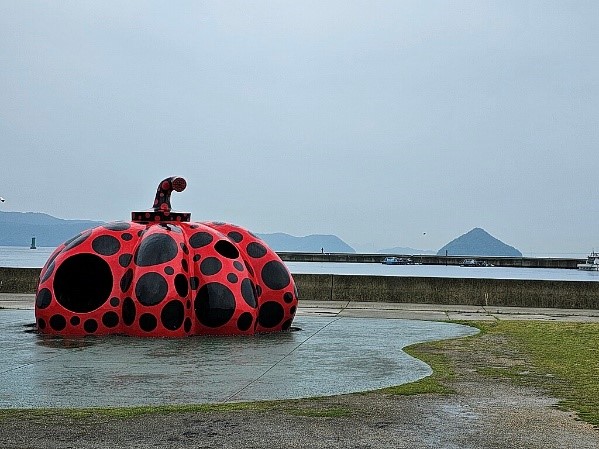
Red Pumpkin by Yayoi Kusama, Naoshima. Image by Piet Parkiet licensed under a Creative Commons Attribution-Share Alike 4.0 International license https://creativecommons.org/licenses/by-sa/4.0/deed.en
About Kusama’s work
Quintessential to Kusama is the use of repeating patterns, particularly polka dots. The breadth of her work is extensive and spans painting, drawing, stand-alone sculpture, and immersive installations as well as video and live performance.2 Kusama has spoken of an all-consuming process, drawing a repetitive pattern for hours until her perception of the pattern extends to a hallucination beyond the bounds of the large canvas to cover the floor and the wall.2 Her work allows viewers to immerse themselves in her unique perceptual world and offers the opportunity to understand her use of art to escape from psychological trauma.2
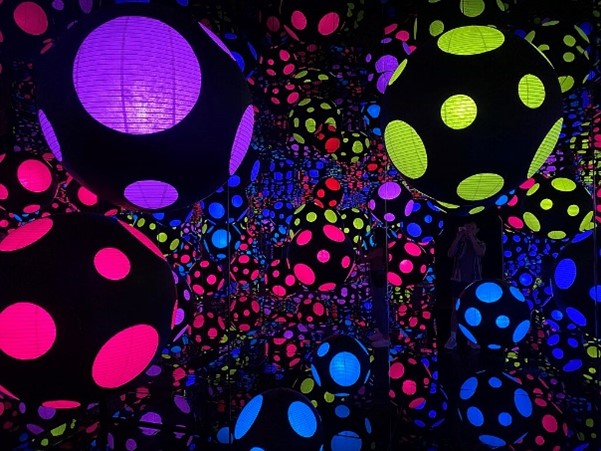
The Infinity Mirrored Room by Yayoi Kusama, Crystal Bridges Museum of American Art. Image by EEJCC licensed under a Creative Commons Attribution-Share Alike 4.0 International license https://creativecommons.org/licenses/by-sa/4.0/deed.en
How do the themes in the work relate to the wider clinical picture?
People living with the effects of psychological trauma and those with serious mental health conditions may turn to many different forms of artistic expression as an outlet. Art therapies as a group of formal interventions have been studied for many years and have been described as enabling individuals “to use art to creatively express themselves and communicate differently with themselves, others, and their reality.”4 Taking the example of art therapy for psychosis, quantitative evidence is limited and beset by methodological problems.4 Yet high-quality qualitative evidence provides support for art therapy as a meaningful and beneficial intervention.4 A systematic review of visual art methods for people living with a mental health condition concluded that expressing feelings and identity through artwork could be considered in holistic treatment planning, potentially facilitating insight into an individual’s concept of recovery.5
Self-determination for people living with mental health conditions is a vital consideration. It could be argued that where someone chooses to or is able to live is a particularly influential factor. People with serious mental health conditions tend to move more frequently and are generally less satisfied with their housing.6 Loneliness can be predicted by housing satisfaction and by the duration of time someone has resided in that living situation, highlighting the importance of not only physical housing but also integration and connection with the local community.6 In-depth interviews with 24 tenants living in supported housing due to serious mental health conditions found that choice was a large contributor to well-being and recovery. A pattern was found, indicating three domains of choice: choosing to be responsible for one’s life, choosing how to organize one’s social life, and choices that lead to a feeling of being “at home.”7
These topics of artistic expression and living provide rich examples of considerations beyond the narrow clinical picture of symptoms. When the goals and experiences of a person living with a serious mental health condition are considered, their conception of recovery can influence the care plan.
Cite this article as Portraits: The Work of Yayoi Kusama. Connecting Psychiatry. Published July 2024. Accessed [month day, year]. [URL]
Disclaimer: The opinions of the artist expressed in their work do not necessarily reflect those of Connecting Psychiatry or Boehringer Ingelheim.
SC-US-77181
SC-CRP-16206
July 2024
Related content

Portraits: The Center Cannot Hold


Sign up now for new features
The newsletter feature is currently available only to users in the United States
*Required field